Architecting and Scaling a Backend Project: Microservices vs. Monolith

The architecture of your backend decides how much of your day is a fight. As the application grows, the cracks in your first choices start to show. You reach a point where you have to pick a direction. Do you keep the monolith, or do you break everything into microservices?
There is no silver bullet. Both approaches have a place. The right choice depends more on your team structure and business stage than on pure technical merit. This post covers the two main options, plus a pragmatic middle ground that often works best.
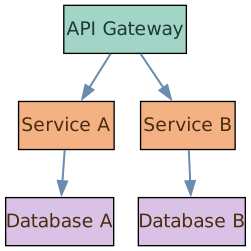
The idea behind Microservices is simple. Instead of building one giant application, you build a collection of small, independent services. Each one does one thing well.
Think of it like a decentralized team. Each service runs its own database and can ship whenever it is ready, without asking the others for permission. The billing team can use Go while the auth team uses Rust, and neither has to compromise. That freedom makes people fast. In theory, at least.
In practice, this suits large organizations where coordinating a single release across 500 developers is a nightmare.
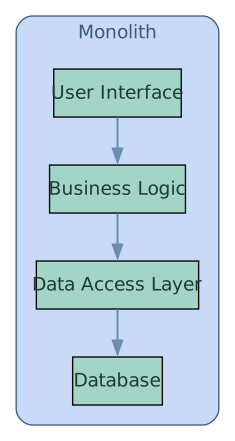
The Monolith is the traditional approach. One codebase, one application, one deployment. Everything lives together, from the user interface to the business logic and data access.
The word "monolith" has become close to a dirty word in some circles. It still has real advantages. It is simple. You never need a map to find where a function is defined. Deployment is a single script. For small to medium teams, that simplicity is a superpower. It lets you move fast without sinking time into infrastructure.
A common anti-pattern in small to medium-sized companies is ending up with more microservices than engineers. I have seen organizations with 100 engineers trying to maintain 300+ services. The result is chaos.
Once you cross that line, many services lose their owners, or the owners inherit services they have no context on because of reorgs. You also spend more time updating dependencies across every repository to clear out vulnerabilities. Microservices done well need a dedicated platform team and serious investment in tooling. Most startups cannot afford that infrastructure, so their "agile" architecture turns into a maintenance nightmare.
Pick an architecture because it solves a problem you actually have. Trends should not enter the decision.
Choose Microservices if:
Choose a Monolith if:
Here is a secret. You do not have to jump straight to microservices. You probably should not.
A Modular Monolith is a solid middle ground. You build a single deployable unit, but inside you enforce strict boundaries between modules. Code in Module A cannot import code from Module B directly. It has to go through a defined public interface. You get the code organization of microservices without the infrastructure overhead.
As the application grows, you peel off the parts that need to be independent.
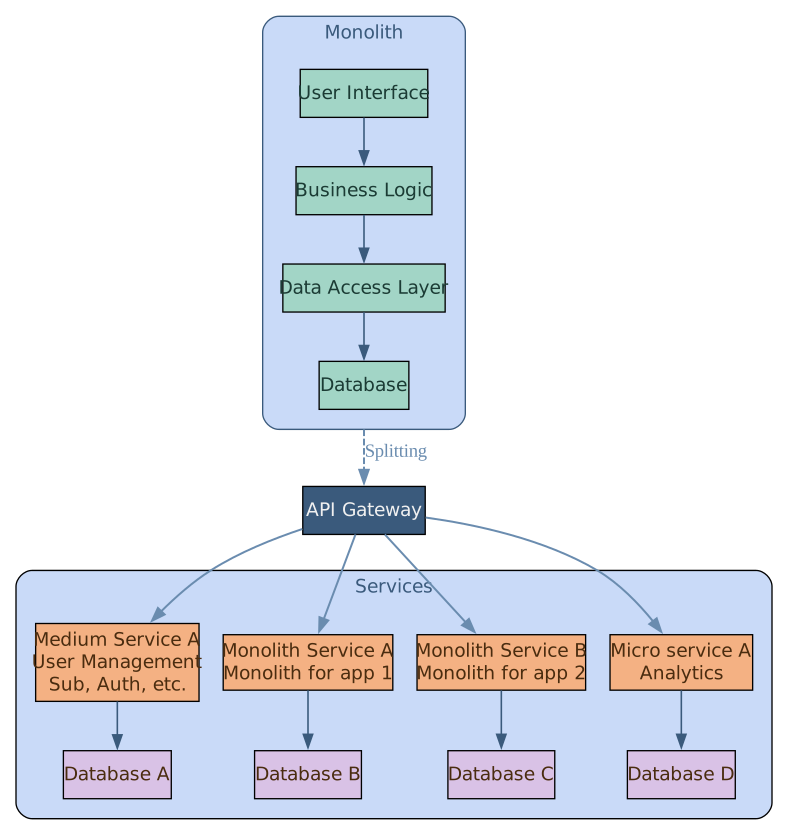
The Microservices vs. Monolith debate usually misses the point. The question is not which architecture is theoretically better. It is which set of trade-offs you can live with right now.
Start with a well-structured monolith. Split it only when the pain shows up. Your future self and your DevOps team will thank you.
© Melvin Laplanche - All rights reserved.